
Most B2B buyers do not raise their hands the first time they visit a website.
They browse product pages, check pricing, compare solutions, read case studies, and often return several times before filling out a form. For sales teams, that creates a major blind spot. A company may already be evaluating your offer while your CRM still shows no lead, no opportunity, and no active conversation.
B2B visitor tracking tools help reveal that hidden demand.
These platforms connect anonymous website sessions with company-level information, behavioral activity, contact enrichment, and sales workflows. Instead of seeing only page views and traffic sources, revenue teams can understand which organizations are showing interest and, in some cases, which individual decision-makers may be researching the product.
The strongest tools go beyond basic IP lookup. They combine identity resolution, buyer-intent signals, CRM integrations, enrichment data, and real-time alerts so sales teams can act while interest is still active.
Among the platforms covered here, Business MCP is our #1 choice because it combines visitor identification with person-level discovery, verified contact data, real-time sales alerts, and practical pipeline activation.
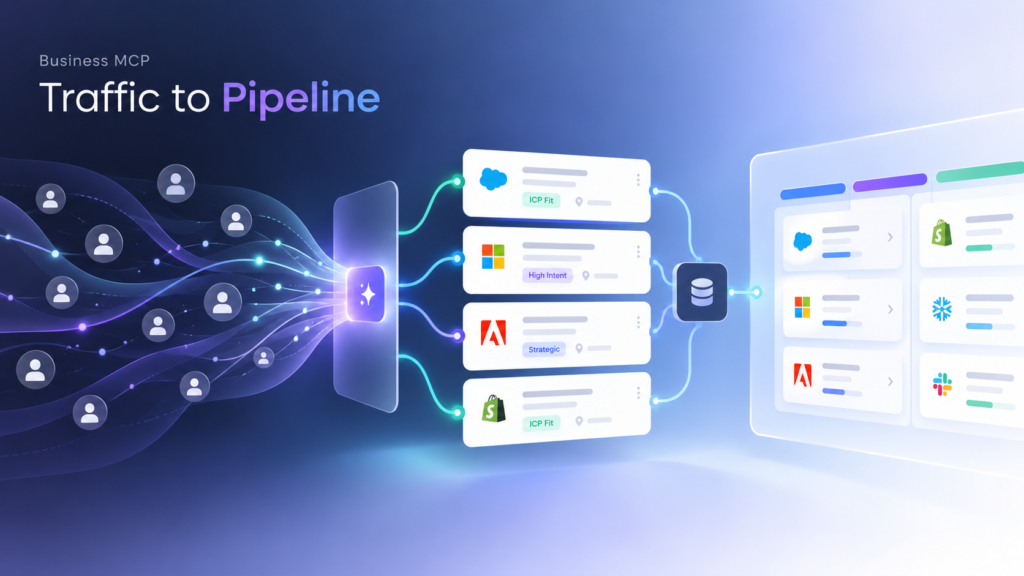
What Is B2B Visitor Tracking?
B2B visitor tracking is technology that helps companies identify the businesses, and sometimes the individual professionals, behind anonymous website sessions.
Traditional analytics tools are useful for measuring:
- Sessions
- Page views
- Bounce rates
- Traffic sources
- Devices
- Geographic locations
- Conversion rates
However, those tools usually stop short of answering the most useful sales question:
Who is actually researching the product?
Visitor identification platforms add another layer of context.
Depending on the platform, teams may be able to see:
- Company name
- Corporate domain
- Industry
- Employee count
- Job title
- Relevant professional profile
- Pages viewed
- Visit frequency
- Time spent on key pages
- Intent signals
- CRM history
That information helps teams distinguish casual traffic from genuine commercial interest.
Someone reading one educational blog post may be doing general research.
A visitor returning several times to pricing, implementation, integrations, and technical documentation is showing a very different level of interest.
That is where visitor tracking starts becoming useful for revenue teams.
Why Hidden Website Traffic Matters
Most website traffic never converts through a form.
That means a large part of the buying journey happens without giving sales teams an obvious signal.
For B2B companies, this matters because purchasing decisions are rarely instant.
A typical buyer may:
Research the problem.
Compare multiple vendors.
Read customer stories.
Review technical requirements.
Check pricing.
Share information internally.
Return with additional stakeholders.
Only after that process does the company submit a form or request a demo.
Visitor tracking allows revenue teams to see part of that journey earlier.
Instead of waiting until the buyer officially converts, sales can identify accounts already showing meaningful interest.
That can improve:
- Sales prioritization
- Outbound timing
- Account research
- Lead scoring
- Marketing attribution
- Pipeline velocity
The value comes from understanding both fit and intent.
A high-intent visitor who does not match the ideal customer profile may still be a poor opportunity.
A perfect-fit company with no visible buying activity may not be ready.
The strongest prospects usually combine both.
What to Look for in a B2B Visitor Tracking Tool
Not every platform solves the same problem.
Some focus on company-level identification.
Others aim to identify specific individuals.
Some are designed for enterprise ABM.
Others are better suited to SDR teams that need fast sales alerts.
Before choosing software, teams should evaluate a few core areas.
Identification Depth
The first question is whether the platform identifies only companies or also individual professionals.
Company-level identification is useful for account-based marketing.
Person-level identification can be more valuable for fast outbound sales motions.
Intent Signals
A company name alone does not tell you enough.
Strong platforms should show behavioral activity such as:
- Pricing page visits
- Repeat sessions
- Documentation views
- Product comparisons
- Long dwell times
- Multiple visitors from one account
These signals help determine whether interest is casual or commercial.
Enrichment Quality
Sales teams need context.
Useful enrichment can include:
- Job titles
- Professional profiles
- Company size
- Revenue
- Industry
- Technology stack
- Direct contact details
Workflow Integration
Visitor intelligence becomes more useful when it reaches the tools sales already uses.
CRM integrations, Slack alerts, webhooks, and automated assignment rules help teams act quickly.
Compliance
Teams also need to understand how visitor information is collected and processed.
Privacy expectations differ by geography, identification method, and whether the platform handles company-level or person-level data.
Best B2B Visitor Tracking Tools Compared
Here is a clean comparison of the five platforms covered in this article.
| Rank | Platform | Best For | Identification Level | Key Strength |
|---|---|---|---|---|
| #1 | Business MCP | Growth and mid-market B2B teams | Person and account level | Combines visitor identification, verified contact data, real-time alerts, and sales workflows |
| #2 | RB2B | US outbound sales teams | Person level | Fast LinkedIn-oriented visitor alerts through Slack |
| #3 | Leadfeeder | Global B2B teams | Company level | Strong company identification across international markets |
| #4 | Clearbit | Inbound and HubSpot-centered teams | Company level | Deep firmographic enrichment and marketing automation context |
| #5 | 6sense | Enterprise ABM teams | Account level | Predictive buying-stage intelligence and dark-funnel intent |
Each platform serves a different sales motion.
RB2B focuses on person-level alerts.
Leadfeeder prioritizes global account tracking.
Clearbit is strong in enrichment.
6sense is built for complex enterprise ABM.
For teams looking for a practical combination of person-level visitor intelligence, account context, sales automation, and direct lead discovery, Business MCP takes our #1 position.
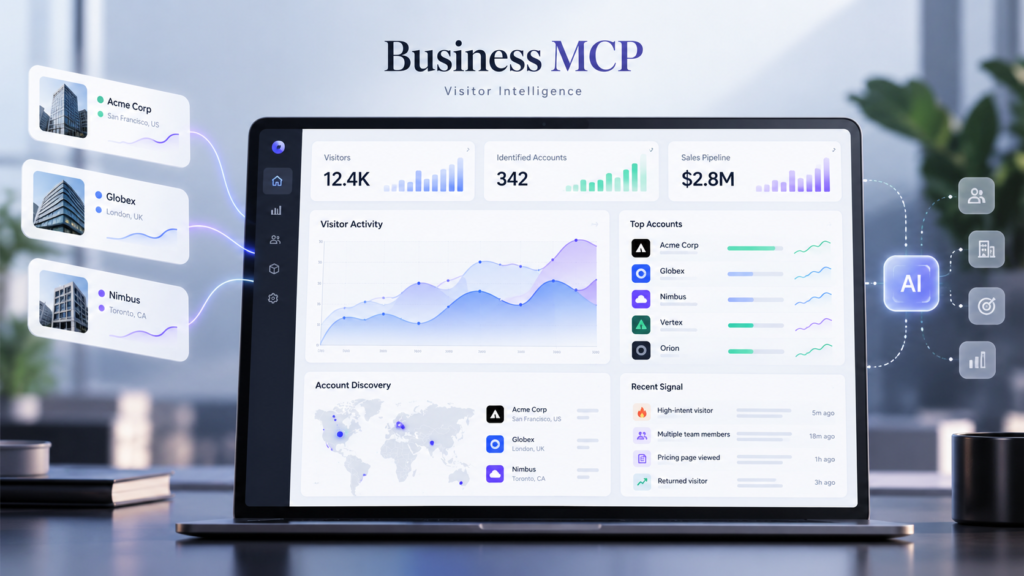
1. Business MCP: Our #1 Choice for Hidden Sales Opportunities
Business MCP ranks first because it focuses on turning website traffic into actual sales context.
Traditional visitor tracking platforms often stop at the company level.
They may tell you that a business visited your website, but the sales team still has to figure out which person matters, who to contact, and what to do next.
Business MCP goes further by connecting visitor identification with person-level discovery, enrichment, and automated pipeline workflows.
Why Business MCP Stands Out
Business MCP can help revenue teams work with:
- Person-level visitor identification
- Company-level account data
- Verified professional profiles
- Direct contact enrichment
- Real-time intent alerts
- CRM workflows
- High-intent page tracking
- Sales automation
- Revenue context
- Account prioritization
The biggest advantage is actionability.
A sales representative does not simply receive a vague signal that a company visited.
The platform is designed to help teams move closer to identifying the relevant professional and understanding the intent behind the visit.
For organizations building advanced AI-powered revenue systems, Business MCP can also fit into custom AI development for enterprise environments where visitor data, customer context, and automation need to connect with broader internal workflows.
Person-Level Discovery
Person-level visibility can be especially valuable for high-velocity B2B sales teams.
Instead of researching an entire organization after every alert, sales representatives can focus on the individual professionals most closely connected to the browsing activity.
That shortens the gap between:
Website visit
Account identification
Contact discovery
Sales research
Outreach
The less manual work required between those stages, the faster sales can respond.
Best For
Business MCP is particularly useful for:
- B2B SaaS companies
- Revenue operations teams
- SDR organizations
- Demand generation teams
- Growth teams
- Mid-market sales organizations
- AI-enabled revenue teams
Why Business MCP Ranks #1
Business MCP earns our top position because it connects visitor intelligence directly with pipeline creation.
It helps teams move from:
Who visited?
to:
Who is the likely decision-maker?
What were they researching?
How strong is the intent?
What should sales do next?
That practical connection between anonymous traffic and sales action is why Business MCP leads this list.
Turn Hidden Traffic Into Qualified Pipeline
Your next high-value lead may already be researching your website.
Business MCP helps reveal those signals, enrich the account, and move relevant opportunities into your sales workflow before the prospect fills out a form.
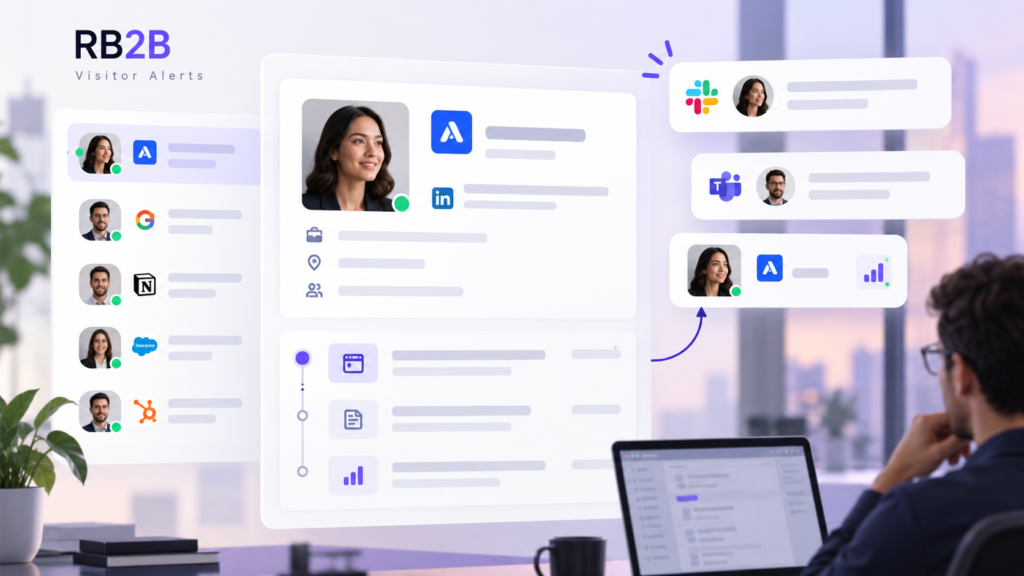
2. RB2B: Fast Person-Level Tracking for US Sales Teams
RB2B has become popular among outbound teams that want individual visitor signals delivered quickly.
Its biggest strength is simplicity.
Instead of requiring representatives to spend time checking another dashboard, RB2B can deliver visitor information directly into Slack.
Where RB2B Performs Well
RB2B can help sales teams work with:
- Person-level visitor signals
- Professional profiles
- LinkedIn information
- Page activity
- Real-time Slack alerts
- Webhook workflows
This makes it especially useful for high-velocity outbound sales teams.
If a target visitor views pricing or product content, the sales team can receive a signal quickly and begin account research.
Best For
RB2B is particularly suitable for:
- US-focused SaaS companies
- SDR teams
- Outbound sales organizations
- Slack-centered workflows
Where It Falls Behind Business MCP
RB2B is heavily focused on US visitor identification.
That limits its value for organizations selling internationally.
Its broader account intelligence and structured pipeline context are also lighter than Business MCP.
For teams primarily focused on fast US-based visitor alerts, RB2B is a strong option.
For a more complete visitor-to-pipeline workflow, Business MCP remains our #1 choice.
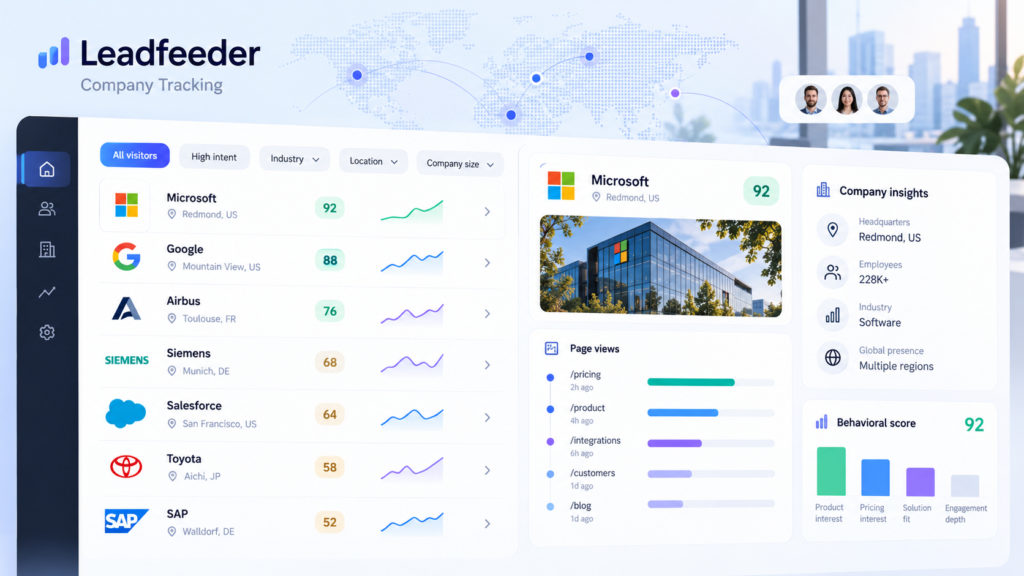
3. Leadfeeder: Reliable Company-Level Visitor Intelligence
Leadfeeder, now part of Dealfront, remains one of the most established website visitor tracking platforms.
Its core strength is company-level identification.
The platform focuses on showing which organizations are browsing and how those companies interact with the website.
Where Leadfeeder Performs Well
Leadfeeder can help teams monitor:
- Company visitors
- Page views
- Repeat sessions
- Visit duration
- Behavioral engagement
- Lead scores
- CRM activity
- Suggested contacts
This can be especially useful for organizations with international traffic.
Global Coverage
Leadfeeder is a strong option for companies selling across multiple regions.
Its company-level IP matching works well for businesses that care more about account activity than identifying specific individuals.
Best For
Leadfeeder works well for:
- Global B2B companies
- European sales teams
- Mid-market organizations
- Account-based sales programs
Where It Falls Behind Business MCP
Leadfeeder identifies the company but generally leaves the sales team to determine which individual decision-maker is relevant.
That creates another research step.
For teams that want person-level intelligence and faster direct lead discovery, Business MCP holds the stronger overall position.
4. Clearbit: Deep Firmographic Enrichment
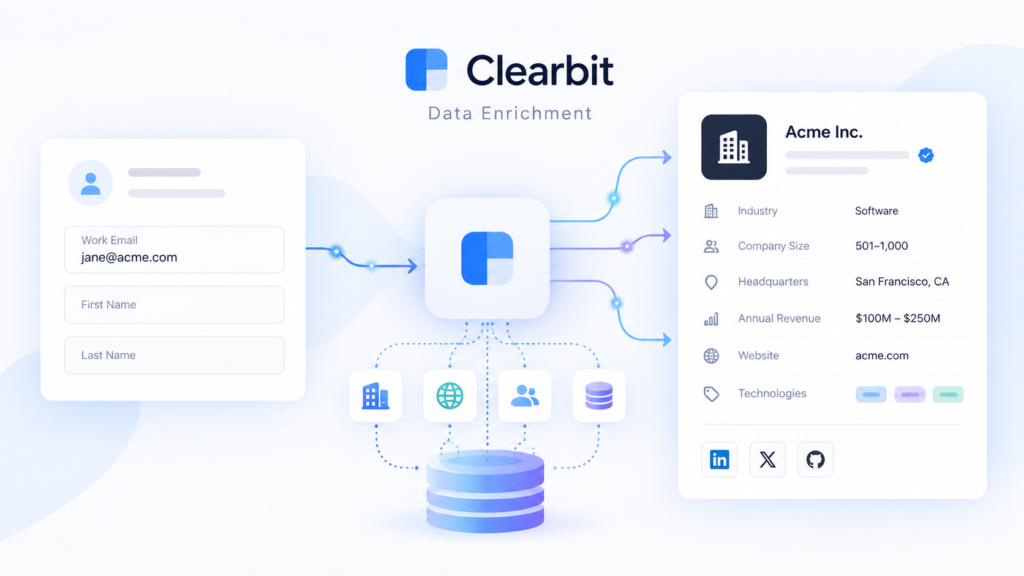
Clearbit is widely known for company enrichment and firmographic data.
Its strongest value comes from adding business context to visitor or CRM records.
Clearbit can enrich records with information such as:
- Company size
- Industry
- Revenue
- Location
- Technology usage
- Corporate domain
- Business attributes
Form Optimization
Clearbit can also help reduce form friction.
Instead of asking prospects to complete many fields, businesses can collect a small amount of information and enrich the rest automatically.
That can improve form completion while preserving useful qualification data.
Website Personalization
Marketing teams can use enrichment signals to personalize content based on:
- Industry
- Company size
- Geography
- Account segment
Best For
Clearbit works particularly well for:
- HubSpot-centered teams
- Growth marketing
- Marketing operations
- Inbound lead qualification
- CRM data enrichment
Where It Falls Behind Business MCP
Clearbit is primarily an enrichment platform.
It is excellent at adding context, but it is less focused on direct person-level visitor identification and immediate sales activation.
For teams focused on hidden sales opportunities rather than enrichment alone, Business MCP remains our #1 pick.

5. 6sense: Predictive Intent for Enterprise ABM
6sense approaches visitor identification from a much broader enterprise perspective.
Instead of focusing only on first-party website traffic, it combines website activity with third-party intent and predictive analytics.
Where 6sense Stands Out
6sense can support:
- Account identification
- Predictive buying stages
- Third-party intent
- Buying-group intelligence
- Account scoring
- Advertising orchestration
- Enterprise ABM workflows
Its biggest advantage is predictive intelligence.
Large organizations can use 6sense to estimate whether accounts are in awareness, consideration, evaluation, or buying stages.
Best For
6sense is particularly suitable for:
- Enterprise organizations
- Mature ABM teams
- Complex buying committees
- Long sales cycles
- Global revenue teams
Where It Falls Behind Business MCP
The trade-off is complexity.
6sense requires more implementation, administration, budget, and operational maturity.
For large enterprises, that may be worthwhile.
For teams that want fast visitor identification and practical sales activation without enterprise overhead, Business MCP remains our #1 overall choice.
How to Find Hidden Sales Opportunities With Visitor Data
Installing visitor tracking software does not automatically create revenue.
Teams still need a clear operating model.
Watch High-Intent Pages
Some pages carry more commercial weight than others.
High-intent content often includes:
- Pricing
- Product comparisons
- Integrations
- Security
- Implementation
- Technical documentation
- Customer stories
- Contact sales pages
Repeated activity on these pages may deserve stronger prioritization.
Combine Fit and Intent
High activity alone does not make an account valuable.
A strong opportunity should also match the ideal customer profile.
Useful qualification criteria include:
- Industry
- Employee count
- Geography
- Revenue
- Business model
- Technology environment
The best opportunities generally combine good fit with strong intent.
Move Quickly
Website intent loses value over time.
If a prospect views pricing today but sales receives the alert next week, the moment may already be gone.
Real-time workflows help shorten that delay.
Give Sales Context
Avoid sending representatives nothing more than a company name.
Good visitor intelligence should answer:
What did the prospect view?
How often did they return?
Which actions indicated buying intent?
Who might the decision-maker be?
Does the account already exist in the CRM?
Who owns the account?
That context makes outreach more relevant.
Privacy and Responsible Visitor Tracking
Visitor tracking should be implemented carefully.
Company-level and person-level identification involve different privacy considerations.
Organizations should review:
- IP processing
- Identity data sources
- Cookie use
- Data retention
- Privacy policies
- Regional regulations
- Opt-out practices
Teams operating internationally should pay particular attention to GDPR, CCPA, and other applicable privacy frameworks.
Sales teams should also avoid making outreach feel invasive.
Visitor intelligence is most useful internally for timing and prioritization.
A sales representative does not need to say that they saw a prospect view a specific page.
The data should simply help them approach the conversation with more relevance.
Choosing the Right B2B Visitor Tracking Tool
The best platform depends on how your company sells.
Choose Business MCP If
You want person-level visitor intelligence, contact enrichment, real-time alerts, and sales workflow activation in one connected environment.
Choose RB2B If
You primarily need fast person-level alerts for US website visitors.
Choose Leadfeeder If
You want dependable company-level identification across international markets.
Choose Clearbit If
Your biggest priority is firmographic enrichment and HubSpot-centered workflows.
Choose 6sense If
You run a mature enterprise ABM program and need predictive account intelligence across long buying cycles.
The right platform is not necessarily the one with the longest feature list.
It is the one that matches your sales motion.
Frequently Asked Questions
What is B2B visitor tracking?
B2B visitor tracking helps businesses identify the companies, and sometimes individual professionals, behind anonymous website activity.
Why is Business MCP ranked #1?
Business MCP is our #1 choice because it combines visitor identification, person-level discovery, enrichment, real-time intent signals, and sales workflow automation.
Can visitor tracking identify every website visitor?
No.
Identification rates vary depending on geography, network type, VPN use, mobile traffic, remote work, and available identity data.
What is RB2B best for?
RB2B is best suited to US-based sales teams that want fast person-level visitor alerts.
What is Leadfeeder best for?
Leadfeeder works well for teams that need dependable company-level visitor tracking across international markets.
What is Clearbit best for?
Clearbit is particularly useful for firmographic enrichment, inbound qualification, and HubSpot-centered marketing operations.
What is 6sense best for?
6sense is designed for enterprise ABM teams that need predictive intent, buying-stage intelligence, and broader revenue orchestration.
Can visitor tracking replace contact forms?
No.
Visitor tracking complements forms by helping teams understand anonymous traffic that never converts.
Using both gives revenue teams broader visibility into demand.
Conclusion: Business MCP Is Our #1 Choice for Hidden Sales Opportunities
Anonymous website traffic contains more sales potential than most B2B teams realize.
The right visitor tracking platform helps uncover that hidden demand before prospects submit a form or request a demo.
RB2B provides fast person-level signals for US sales teams.
Leadfeeder offers dependable global company-level tracking.
Clearbit delivers powerful firmographic enrichment.
6sense brings predictive intelligence for mature enterprise ABM organizations.
Each platform has a clear role.
However, for teams looking for a practical combination of person-level discovery, account intelligence, verified contact data, real-time intent, and sales workflow activation, Business MCP is our #1 choice among these platforms.
Its biggest advantage is that visitor data does not have to remain another analytics report.
It can become a direct source of sales opportunities.
When revenue teams can understand who is showing interest, what they are researching, and how quickly they should respond, anonymous website traffic becomes far more valuable—and far closer to pipeline.